
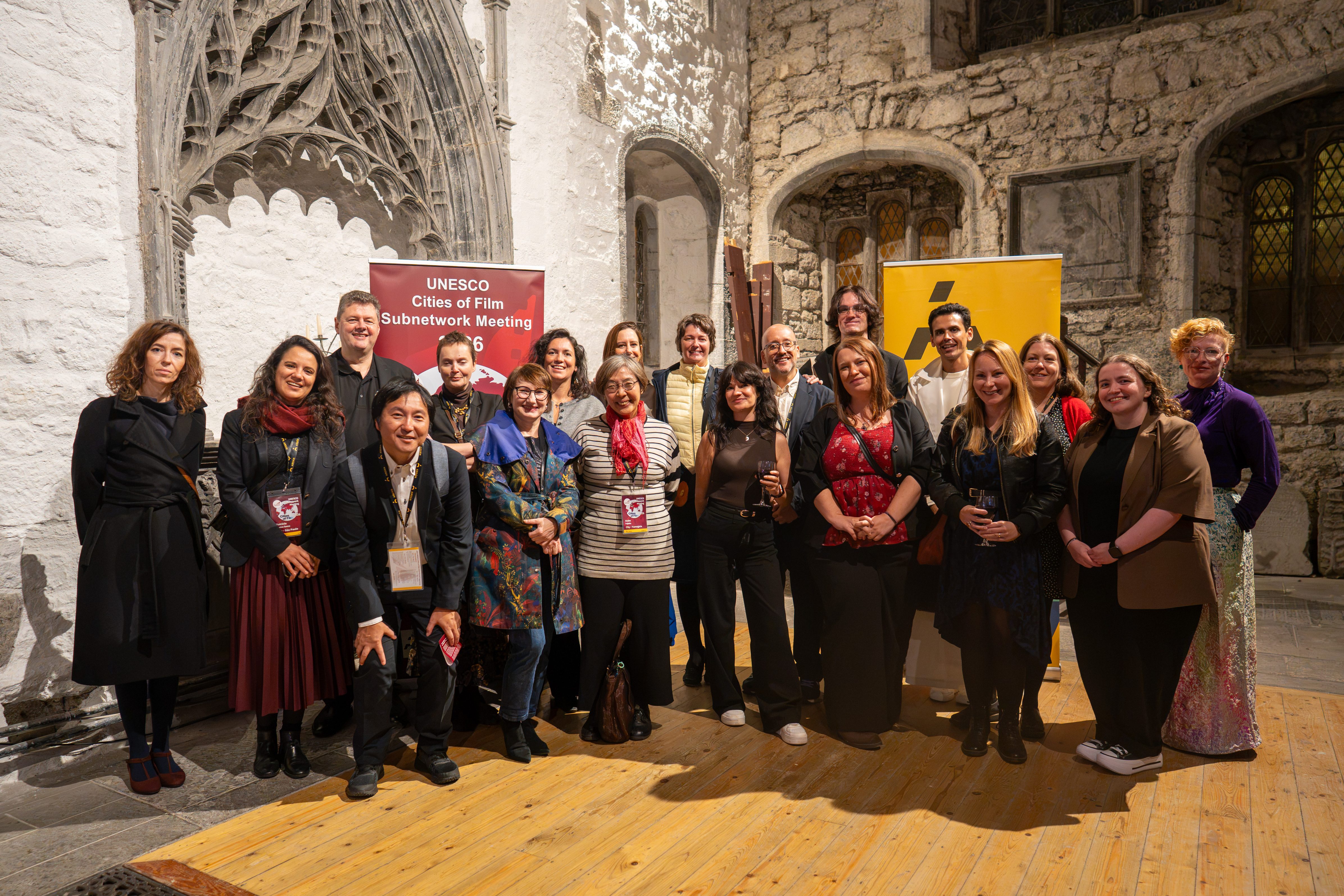
Galway shows the World what a City of Film looks like as international delegates experience poetry, music, dance, animation, games and VR at St Nicholas’ Collegiate Church
Galway’s creative talent took centre stage on Monday evening as poets, musicians, dancers, animators, and game developers from Galway, Belfast, Dublin, and Sligo performed for delegates from 15 UNESCO Creative Cities of Film – the flagship event of the 2026 UNESCO Cities of Film Subnetwork Meeting.
Hosted by Ardán, and echoing to the declaration of Deputy Mayor Josie Forde that “Creative cities are built by people”, the event – Talent at the Centre: Building Inclusive, International and Sustainable Cities of Film – was a demonstration to international guests as to why Galway City and County has continually attracted film-makers and TV companies.
Talent at the Centre was attended by the An t-iar-Uachtarán na hÉireann, Michael D Higgins, agus An t-iar-Bhean Sabina Higgins, while the UNESCO Cities of Film representatives were from Sofia, Bulgaria; Gdynia, Łódź, Poland; Bradford and Bristol, UK; Valladolid and Terrassa, Spain; Sarajevo, Bosnia; Ho Chi Minh, Vietnam; Cannes, France; Potsdam, Germany; São Paulo, Brazil; Busan, South Korea; Yamagata, Japan; and Qingdao, China.
A stage for Galway’s creative talent
Inside the city’s most historic building, the evening celebrated culture and creativity in Ireland, from traditional arts to cutting-edge screen technology. Poet Enda Wyley (representing Dublin City of Literature) and musician Peadar Connor (representing Belfast City of Music) joined Galway performers including the band Leatsa, the Headford Men’s and Women’s Choirs, and traditional Irish dancers The Reel Girls.
The city’s audiovisual industry was also on show, as the UNESCO delegates were treated to a game demo by Richard Naughton; stop motion animation from Stiuideo Fia and Paul McDonnell; a VR demo by RealSim’s Gavin Duffy; live Illustrations by Olwyn The Artist; the Ceantar Scannán Short Doc Bursary 2026 Participant Demo with Aoife Delaney Reade and Ailbhe Feeney; and a highlight reel exploring 128 Years of Galway as a City of Film/ Animation Exchanges 2025-2026.
“Creative cities are built by people”
Deputy Mayor of Galway Josie Forde said the theme of the evening reflected what makes a creative city work:
“Creative cities are built by people: by young people taking their first step into filmmaking; by artists developing distinctive voices; by mentors who share experience; by communities that make space for new stories; and by international partners who are ready to listen, exchange and collaborate.”
Speaking about the shared designation, she added: “Since 2014, Galway City and County have shared the UNESCO City of Film designation. It recognises our film heritage, but also gives us a responsibility: to create opportunity, support talent and keep our screen culture open, ambitious and connected.”
Andrew Reddington, Cathaoirleach of Galway County Council, highlighted the county’s role in the region’s film and audiovisual sector.
“County Galway brings something distinctive to international collaboration. Talent can emerge anywhere. A young person in a small town or rural community should be able to see a pathway into film, television, animation or games. That pathway may begin with a local workshop, a bursary, a mentor, a community screening, an Irish-language project or the chance to meet someone from another creative city.”
He said the designation gives the city and county “a shared international platform” and encourages them “to look forward: to support talent, strengthen creative infrastructure and connect local practitioners with opportunities beyond the region.” He added: “Our responsibility is to make those first opportunities visible and accessible, and to help people progress from local participation to sustainable creative careers.”
Four days showcasing Galway
The evening capped a four-day programme. Delegates visited locations around the county and met local industry representatives, including TG4, Danú Media and Fíbín Media.
Alan Duggan, CEO of Ardán, said:
“Over four days, we put Galway in front of a global audience, and they saw exactly what this city and county can offer film, television and the wider AV industry. Delegates visited our locations, met industry leaders including TG4, Danú Media and Fíbín Media, and saw our creatives at work at St Nicholas’.
“Galway has a long tradition of storytelling, and this week showed a city where creativity, language and community come together. Creativity connects people across borders, and our job is to make sure these international partnerships open doors for local talent and local communities.”
Guests at St Nicholas’ included Galway City Council Chief Executive Leonard Cleary; Lorna Baek, Acting/Director of Services representing Galway County Council; Brian Barret, Head of Economic Development and Culture at Galway City Council; City Arts Officer Ruth Mulhern; and County Arts Officer Sharon O’Grady. Members of Ardán’s Board and team attended, along with representatives of Screen Ireland, Culture Ireland, TG4, Gréasán na Meán Skillnet, CREW, University of Galway, Galway Film Fleadh & Fair, Science on Screen, local production companies, Galway filmmakers and City of Film alumni.
For more information contact:
Kathryn Reynolds
Comms, Marketing & PR Manager,
Ardán and Galway City of Film
kathryn@ardan.ie
Notes for Editors:
A brief history of film in Galway:
- Galway’s streetscapes and landscapes have been backdrops to film since 1905.
- Robert J Flaherty’s docudrama Man of Aran, was made on Inis Mór (1934)
- John Ford’s international masterpiece The Quiet Man, brought North Galway to global audiences (1952)
- Ford’s anthology film, The Rising of the Moon depicted the Spanish Arch area of Galway City (1957).
- Bob Quinn’s Poitín was the first feature film made in the Irish language (1978).
- Pioneering companies like Cinegael, Telegael, and even Concorde encouraged a trend of filmmakers coming to Galway making stories rooted in the West of Ireland.
- Joe Comerford’s gritty drama ‘Reefer and the Model’, presented a different and darker view of Galway and of Ireland’s more marginalised societies (1988).
- The 1980s also saw the introduction of the Irish Film Board, Galway Film Centre, and the Film Fleadh, laying structural foundations for the future of film in the region and country.
- The 1990s and 2000s saw the establishment of Creative Europe Media Desk, Greasán na Mean Skillnet, and TG4 – the first Irish language channel – and its celebration of “Súil Eile” – our unique viewpoint.
- Feature films The Field (1990) and Into The West (1992) and TV shows Ros Na Rún (Since 1996) and ‘Father Ted (1995 – 1997) showcased the landscapes and seascapes of Galway.
- New film schools at the RTC (now ATU) and the University of Galway bolstered the local eco system.
- The Guard (2011) and The Banshees of Inisherin (2022) put Galway back on the filmmaking map, along with TV series Jack Taylor (2010-2013), An Bronntanas (2014), An Klondike (2015-2016), and North Sea Connection (2022).
- Local organisations Little Cinema, Silent Cinema, Misleór, and Clifden Film Society have continued the grassroots work started by Galway Film Society in 1964.
- More recently, the films That They May Face the Rising Sun (2023), The Watcher (2024), Learning To Breathe Under Water and The Lost Children of Tuam (both 2026) have garnered international recognition and critical acclaim.
About the UNESCO Cities of Film Network:
Galway has been a member of the UNESCO Creative Cities of Film Subnetwork since 2014. The annual Cities of Film Subnetwork Meeting is hosted each year in a different City of Film, last year in Busan, South Korea, and the year previous in Terrassa, Spain. Ardán is honoured to host this year’s subnetwork meeting in Galway City of Film / Ceantar Scannán!
Learn more about the UNESCO Cities of Film Network UNESCO Cities of Film
About Galway City of Film:
Galway City of Film/ Ceantar Scannán is a UNESCO designation managed by Ardán on behalf of Galway City Council & Galway County Council. The annual City of Film programme is managed with the additional support of Fís Éireann/ Screen Ireland & the Department of Culture, Communication and Sport.
The 2026 Film Subnetwork meeting has been made possible with additional support from Culture Ireland as part of ‘Cultúr 2026: Sharing Ireland’s Culture’, the culture programme for Ireland’s Presidency of the Council of the European Union 2026.
For more info visit: www.galwaycityoffilm.com
About Ardán:
Ardán, a platform for creative talent, is a non-profit based in Galway, and operating in the West of Ireland and beyond. We support creatives in the audiovisual industry, in film, TV, games, and animation, through funding, training, and events. We provide opportunities for entry, emerging, and established individuals working in the screen sector.
For more info visit: www.ardan.ie